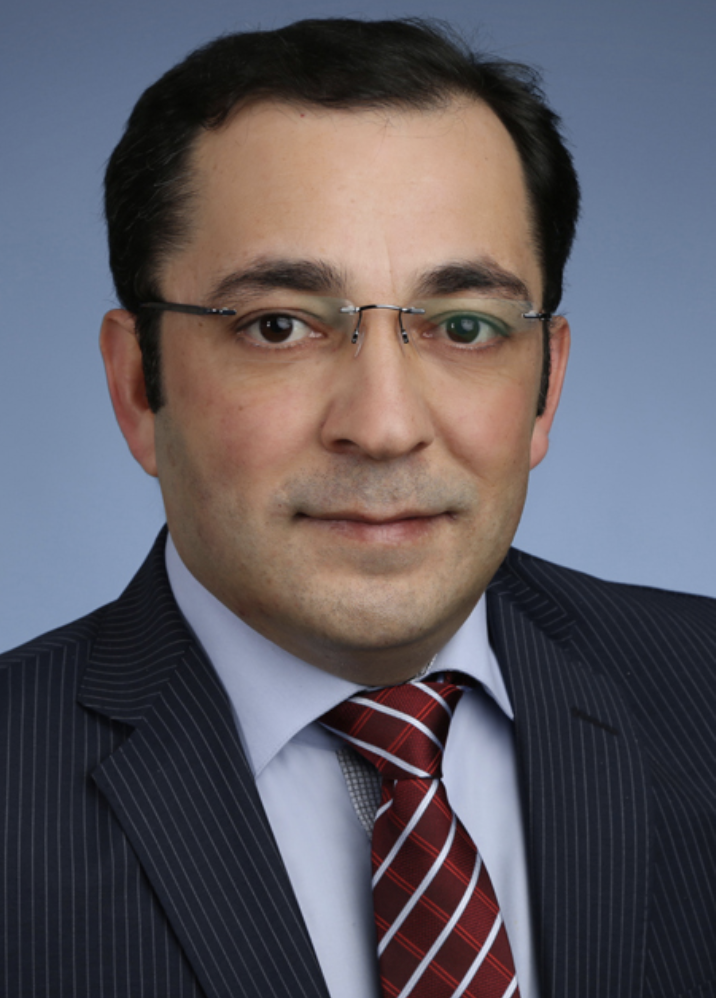
Portrait of Anar Rustamov

Academic curriculum vitae

Anar Rustamov

Profile & Research Focus

Research profile spanning relativistic heavy-ion collisions, QCD matter, fluctuation observables, particle identification methods, and physics analysis in large international collaborations.

Heavy-Ion Phenomenology Nuclear Interactions Scientific Computing Monte Carlo Methods Fuzzy Logic Artificial Intelligence

Scientific Leadership

  • 2024– Physics Coordinator, HADES
  • 2019– Physics Working Group Convener, E-by-E Fluctuations, CBM
  • 2016–2020 Physics Analysis Group Convener, E-by-E Fluctuations, ALICE
  • 2016– Team Leader, Azerbaijan/Baku group in ALICE

Academic Appointments & Employment History

2016– GSI Helmholtzzentrum für Schwerionenforschung — Senior Scientist (ALICE, HADES, CBM)
2016 Ruprecht-Karls-Universität Heidelberg — Visiting EMMI Professor (ALICE, Phenomenology)
2014–2016 Frankfurt Institute for Advanced Studies — Scientific Researcher
2011–2014 Goethe-Universität Frankfurt — Postdoctoral Researcher (NA49, NA61/SHINE)
2006–2011 GSI Helmholtzzentrum für Schwerionenforschung — Postdoctoral Researcher (HADES)
2003–2006 Technische Universität Darmstadt — PhD Student (HADES)
2002–2003 GSI Helmholtzzentrum für Schwerionenforschung — Guest Scientist (HADES)
2000–2002 Joint Institute for Nuclear Research, Dubna — Junior Scientific Researcher

Education, Habilitation & Academic Qualifications

  • 2025 Privatdozent, Goethe-Universität Frankfurt
  • 2024 Habilitation, Goethe-Universität Frankfurt
  • 2018 Dr. of Physics Habilitation, Baku, Azerbaijan
  • 2003–2006 Technische Universität Darmstadt — PhD, “Exclusive η meson reconstruction in p-p collisions at 2.2 GeV with the HADES Spectrometer and high-resolution tracking”
  • 1998–2000 Baku State University — Master degree, Theoretical and Mathematical Physics
  • 1994–1998 Baku State University — Bachelor degree, Physics

Methodological Contributions & Analysis Frameworks

  • Novel technique for analyzing experimental data with incomplete particle identification; used in ALICE, NA49, NA61/SHINE and HADES.
  • Innovative tools for confronting experimental results with theoretical predictions; used in ALICE, STAR and HADES.
  • Procedure for calculating baselines for experimental measurements; used in ALICE, STAR and HADES.

Scientific Service & Community Leadership

Organization of Workshops & Conferences

  • Quark Matter 2025, XXXI International Conference on Ultra-relativistic Nucleus–Nucleus Collisions, 2025 (LOC)
  • Fluctuations and Correlations of Conserved Charges in Nuclear Collisions – Challenges and Future Prospects, EMMI Rapid Reaction Task Force, 2023
  • The International Conference on Critical Point and Onset of Deconfinement, CPOD 2022
  • The International Conference on Critical Point and Onset of Deconfinement, CPOD 2021
  • Critical Fluctuations near the QCD Phase Boundary in Relativistic Nuclear Collisions, 2017

Committees & Scientific Service

  • Member of the International Advisory Committee of CPOD
  • Member of the Local Organising Committee of Quark Matter 2025

Selected Publications & Scholarly Output

View full publications page

Phenomenology and theory

  1. A. Rustamov, “Fuzzy logic for reconstructing arbitrary moments of multiplicity distributions,” Phys. Rev. C 110 (2024) 064910.
  2. P. Braun-Munzinger, K. Redlich, A. Rustamov, J. Stachel, “The imprint of conservation laws on correlated particle production,” JHEP 08 (2024) 113.
  3. R. Holzmann, V. Koch, A. Rustamov, J. Stroth, “Controlling volume fluctuations for studies of critical phenomena in nuclear collisions,” Nucl. Phys. A 1050 (2024) 122924.
  4. P. Braun-Munzinger, B. Friman, K. Redlich, A. Rustamov, J. Stachel, “Establishing a non-critical baseline for fluctuation measurements,” Nucl. Phys. A 1008 (2021) 122141.
  5. P. Braun-Munzinger, A. Rustamov, J. Stachel, “Bridging the gap between event-by-event fluctuation measurements and theory predictions in relativistic nuclear collisions,” Nucl. Phys. A 960 (2017) 114–130.

Experiments, principal author

  1. ALICE Collaboration, “Probing Strangeness Hadronization with Event-by-Event Production of Multistrange Hadrons,” Phys. Rev. Lett. 134 (2025) 022303.
  2. ALICE Collaboration, “Closing in on critical net-baryon fluctuations at LHC energies,” Phys. Lett. B 844 (2023) 137545.
  3. ALICE Collaboration, “Global baryon number conservation encoded in net-proton fluctuations measured in Pb-Pb collisions at √sNN = 2.76 TeV,” Phys. Lett. B 807 (2020) 135564.
  4. NA49 Collaboration, “Phase-space dependence of particle-ratio fluctuations in Pb+Pb collisions from 20A to 158A GeV beam energy,” Phys. Rev. C 89 (2014) 054902.
  5. HADES Collaboration, “Inclusive dielectron spectra in p+p collisions at 3.5 GeV,” Eur. Phys. J. A 48 (2012) 64.

Technical Competencies & Scientific Computing

  • C++, Fortran, Python, CERN-ROOT
  • Algorithms and data structures, Monte Carlo simulations
  • Analysis of experimental data in ALICE, HADES, NA49, and NA61

Languages & International Communication

Azerbaijani Native
Turkish, Russian As native
English Fluent
German Fluent